
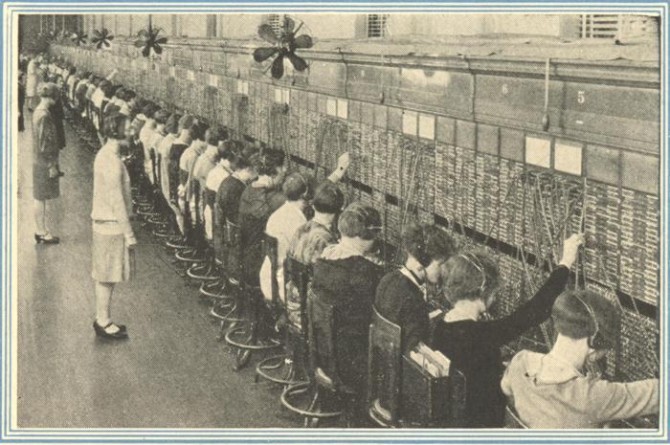
How many of you can remember picking up the receiver of the telephone and hearing this familiar phrase — “Number, please?” I would imagine that not too many of you did. This salutation began at the late end of the 1800’s when “Ma Bell” was still in its infancy. Telephone use was still pretty new to the general public and because of the lack of overhead electrical or telephone wiring, most of the country was not yet connected to the vast telephone networks developing around the nation. Big cities like New York and Chicago were the first to see widespread telephone use. For those working in big business and finance, telephone service was a steal at $1.50 a month. Not so much for the average blue collar worker who was making only that $1.50 per day! As more and more customers signed up for service, local switchboards grew in number, and this created lots of new jobs for millions of lonely housewives, enterprising young teens, and lots of folks who had limited skills and no formal schooling. Manning a switchboard calling center didn’t require much training, but it did require you to be both quick and efficient. Calls coming into the center, especially around midday, ranged from the low of 25 calls per hour to sometimes over 200. That was a lot of activity for such a small company at the time.

Starting in January of 1878, in order to handle the tremendous volume of calls, the Boston Telephone Dispatch Company had started hiring boys as telephone operators. Boys had been very successful as telegraphy operators, but their attitude, lack of patience, and somewhat rude behavior was unacceptable for live telephone contact, so the company began hiring women operators instead. The numerous complaints of “snootiness”, lack of patience, and considerable discourtesy by the boys forced many telephone companies across the nation to begin hiring strictly females. The only issue with this was that some of the telephone jacks on the huge input panels were too high for a lot of the women to reach to be able to connect the corresponding telephone cord, so they had to stand up on their mostly unsteady chairs. And with their extremely long dresses with bulky petticoats underneath, they were almost certain to become unbalanced and fall off their chairs. Thus, the practice of hiring one very tall and lanky young man for every office for every shift was permanently adopted. When a situation arose where the help of the young man was needed, the woman operator would blow a dog whistle and the boy would quickly scramble over to assist. Many young women joked that summoning them using this method gave the guys a taste of their own medicine implementing this “dog whistle” in contrast to their so called “cat calls”.
In 1917, at the beginning of WW1, General Pershing sent out a plea to nearly 500 established small telephone companies across the United States asking to recruit up to 300 able-bodied “telephone operators” to come and join the Armed Forces to create a communications network (the U.S. Army Signal Corp.) within the war department. There were a few prerequisites. They would need to speak both English and French, be physically fit, at least 25 years of age and be a U.S. citizen. Once chosen, they were to be issued uniforms, given ranks, and subject to inspections like any other soldier. 7000 women applied, but only 223 were accepted. Those elite women were dubbed the “Hello Girls”. For 3 years, they worked with the Army making sure that phone calls were connected promptly and efficiently between the Americas and Europe. As the conflict grew to a close, they began the process of becoming civilians once again. Some of the ladies continued their service after the Armistice. They were transferred to Paris and began being discharged in 1919. The final operator was discharged on January 20, 1920. Chief Operator Grace Banker was awarded the Distinguished Service Medal. Although the “Hello Girls” served in the military, wore Army uniforms, and were subjected to Army regulations, they were denied honorable discharge papers, because they were considered civilian employees by the Army. These women who served their time for the good of their nation were deprived of one of the most important benefits given to all service personnel. Between 1927 and 1977, many bills were introduced to Congress to obtain recognition for the “Hello Girls”. Most of their efforts fell on deaf ears. All except for one. One of the more outspoken of the “Hello Girls”, Merle Egan Anderson, continued these efforts into the 1970s along with the help of the Veteran Affairs Administration and the American Legion. Their combined efforts finally persuaded Congress to pass a bill, and it was signed into law by President Jimmy Carter in November 1977. It only took 60 years after the end of World War I, but the “Hello Girls” were finally recognized as United States Armed Service veterans and received their honorable discharge papers. It’s nice to see that Justice still prevails.
FYI… my two oldest sisters, Celia and Rene both worked as telephone operators right out of high school in Red Bank, New Jersey. I think they were assigned to either Directory Assistance or Coin Refund. I imagine that those jobs were less stressful.
Thanks for reading my blog. If you enjoyed this story, make a comment and tell me. If you haven’t already subscribed please do, so you don’t miss any of my enlightening yarns.
Ciao! Lenny
Discover more from Lenny Ricci, Author
Subscribe to get the latest posts sent to your email.

Len, Loved this one. I had to laugh at the comments about men not making good operators due to rude behavior and no patience. Also laughed at having one tall man assigned to each office to reach high up for the ladies. I could just picture the ladies in their long dresses and heavy petticoats trying to stand up on their chairs. Hysterical! I didn’t know about the ladies not being considered military for all those years. Very interesting facts given here. Like I said, I loved it. Keep up the good work.
Betty
LikeLike